Research Framework
A brief overview of the academic foundation, target users, and narrative mechanisms that shaped this interactive Chicago Fire experience.
"How can interactive digital storytelling using survivor narratives reshape public understanding and emotional engagement with historical urban disasters?"
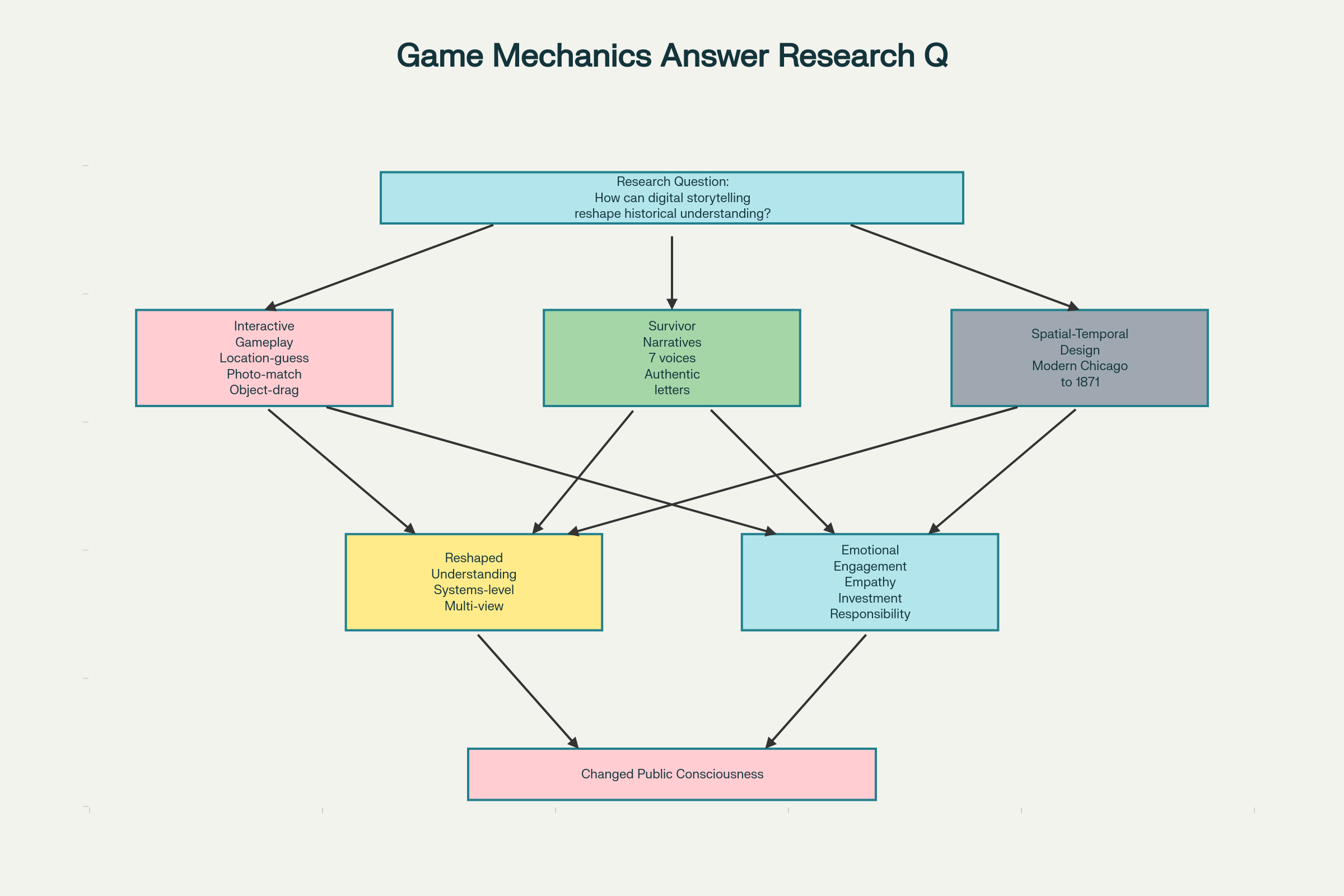
Academic Relevance:
- Digital Heritage Theory: The project addresses a core challenge—how to preserve fragile 150-year-old letters while making them more engaging and accessible than traditional archival storage.
- Serious Games turned into Digital Game: Tests whether games can serve legitimate cultural preservation and educational purposes, not just entertainment.
- Historical Narrative Studies: Explores whether authentic survivor voices + interactive participation reshape how people conceptualize historical events.
Societal Relevance:
- Climate & Disaster Resilience: As climate change intensifies urban disasters, understanding how past communities survived becomes actionable knowledge for contemporary cities.
- Intergenerational Memory: With direct survivors aging out, digital games preserve testimonies for generations who won’t have access to living witnesses.
- Educational Crisis: Traditional history teaching fails to engage digital-native learners; games reach audiences who ignore textbooks.
- Raising Awareness: Connects historical and contemporary urban vulnerability through immersive survivor narratives, forcing players to emotionally recognize disaster inequality and modern city fragility.
- Urban Planning & Public Participation: Historical narratives help communities understand why resilience planning matters.
The game serves seven primary target groups, each with distinct needs:
| Target Group | Age Range | Primary Need | How They Use It |
|---|---|---|---|
| Students | 13-25 | Engaging history learning beyond textbooks | Classroom assignments, independent research, casual play |
| Museum Professionals | 25-60 | Visitor engagement + digital innovation | Museum installations, pre-visit engagement, school programs |
| Casual Players | 12-65 | Entertainment + meaningful learning | Tourism app, leisure gaming, family activity |
Key User Insight: Each group has different motivations but the same core benefit: understanding the Great Chicago Fire as a systems-level disaster affecting different communities differently, while caring emotionally about survivors' stories.
Through embodied, multi-perspective, emotionally-resonant participation in authentic survivor experiences that progressively builds:
- Systems-level understanding (not facts)
- Durable emotional investment (not intellectual interest)
- Civic responsibility (not passive consumption)
Historical understanding and emotional engagement are not passive absorption of facts, but active co-creation of meaning through interactive participation with authentic survivor voices in spatially and temporally meaningful contexts.
- 1. Angle, P. M. (Ed.). (1971). The Great Chicago Fire. Chicago Historical Society. - link to the book
- 2. Gee, J. P. (2003). "What video games have to teach us about learning and literacy," Computers in Entertainment, 1(1), 20–20.
- 3. Green, M. C., & Brock, T. C. (2000). "The role of transportation in the persuasiveness of public narratives," Journal of Personality and Social Psychology, 79(5), 701–721.
- 4. UNESCO. (2003). Charter on the Preservation of Digital Heritage. United Nations Educational, Scientific, and Cultural Organization. Paris.
- 5. Barsalou, L. W. (2008). "Grounded cognition," Annual Review of Psychology, 59, 617–645.
- 6. Murray, J. H. (2011). Inventing the medium: Principles of interaction design as a cultural practice. MIT Press.
- 7. Larson, E. (2003). The Devil in the White City: Murder, Magic, and Madness at the Fair that Changed America. Crown Publishers.
- 8. Nagamatsu, T. (2021). "Why does disaster storytelling matter for a resilient society?," Disaster Prevention and Management, 30(2), 234–245.
- 9. Miller, D. L. (1996). City of the Century: The Epic of Chicago and the Making of America. Simon & Schuster.
- 10. Unity Technologies. (2024). Unity Manual (Version 2023 LTS). Retrieved from https://docs.unity3d.com/
This section lists the historical images used in the project together with their source links for proper attribution.
- oldchicagomap.jpg – https://commons.wikimedia.org/wiki/
- 1928watertower.jpg – https://chicagology.com/prefire/prefire078/
- 1929watertower.jpg – https://chicagology.com/prefire/prefire078/
- 58183-waterworks-1891.jpg – chicagomag.com/.../joseph-kirkland-chicago-fire-photos
- Court House Shortly.png – https://greatchicagofire.org/item/ichi-64281/
- Near North Side ruins.png – alamy.com/...near-north-side...
- Oleary home 2.jpg – http://www.encyclopedia.chicagohistory.org/pages/6335.html
- Portland_Block.jpg – https://chicagology.com/rebuilding/rebuilding041/
- Second Presbyterian Church.jpg – https://glessnerhouse.blogspot.com/2021/08/chicago-fire-stories-part-i-second.html
- SecondPres church.jpg – https://chicagology.com/prefire/prefire079/
- The Lind Block after the Fire; P. B. Greene, Stereograph, 1871.jpg – https://greatchicagofire.org/item/ichi-64152/
- The Sergeant Building befo.jpg – https://greatchicagofire.org/item/ichi-64373/
- centralhighschool1857.jpg – https://chicagology.com/prefire/prefire017/
- chicago museum before.jpg – https://greatchicagofire.org/item/hb-00888-g2/
- chicagowatertower1927.jpg – https://chicagology.com/prefire/prefire078/
- court house 5.jpg – https://chicagology.com/prefire/prefire003/
- court house befo.jpg – https://greatchicagofire.org/landmarks/chamber-of-commerce/
- court house befor randolph.jpeg – https://greatchicagofire.org/item/ichi-62080/
- court side city core.jpg – alamy.com/...dearborn-street...
- courthouse 4july1855hesler.jpg – https://chicagology.com/prefire/prefire003/
- fire_background.jpg – https://ssnd.org/the-great-chicago-fire-part-i/
- modern_history_museum.png – https://en.wikipedia.org/wiki/Chicago_History_Museum
- olary home.jpg – https://greatchicagofire.org/landmarks/oleary-home/
- old water tower.jpg – https://greatchicagofire.org/item/ichi-06859/
- ichi-06859 (alt).jpg – https://chicagology.com/prefire/prefire079/
- to the people.png – https://archive.org/details/greatchicagofire00angl
- washington street.jpg – https://greatchicagofire.org/item/ichi-63070/
- washington street.png – https://greatchicagofire.org/item/ichi-63070/
- water tower color.jpg – https://chicagology.com/prefire/prefire078/
- watertower1871b.jpg – https://chicagology.com/prefire/prefire078/
- chicagohs1886map.jpg - "https://chicagology.com/chicagohs1886map.jpg"