Project Overview
Developed during the Digital Heritage course at Politecnico di Torino, this project turns 150-year-old survivor letters from the Great Chicago Fire into an interactive digital experience.
Created by Ainur Sekerbekova, Tarlan Tleubay, Ehsan Mirzaeisahlabadi, and Tommaso Maria Alesso under the supervision of Prof. Rosa Rita Maria Tamborrino, Prof. Pelin Bolca, and Prof. Sofia Darbesio.
Dimension 1 — Social Impact: The Great Chicago Fire (October 1871) killed 300 people, left 90,000 homeless, and destroyed $200 million in property.
Dimension 2 — Available Evidence: Seven first-hand letters from survivors provide authentic voices:
- Jonas Hutchinson (lawyer) → institutional collapse
- Mary Fales (lawyer’s wife) → family displacement
- George Howland (school principal) → loss of knowledge
- Aurelia R. King (merchant’s family) → survival and faith
- Anna E. Higginson (real estate broker’s wife) → preservation consciousness
- Adeline Rossiter Judd (volunteer helper) → mutual aid
- Samuel Stone (assistant librarian) → vision for rebuilding
Dimension 3 — Geographic Specificity: Mapping physical locations creates embodied learning.
Dimension 4 — Narrative Power: From destruction → survival → rebuilding.
Dimension 5 — Audience Engagement: Narrator-guides + interactive mechanics.
Step 1 — Conceptualization: Defining the research question on emotional engagement.
Step 2 — Tool Selection: QGIS for mapping, VS Code for dev, Adobe Premiere for visuals.
Step 3 — Implementation: GitHub repository structure with game engine and data.
Step 4 — Heritage Integration: Linking to Chicago History Museum archives.
- Preservation: protecting fragile 150-year-old documents.
- Accessibility: Making archives available worldwide via smartphones.
- Enhanced Interpretation: Adding voice acting and spatial context.
- Intangible Heritage: Returning written text to oral storytelling.
- Educational Reuse: Enabling use in schools and documentaries.
| Criterion | Your Project |
|---|---|
| Purpose | Education + Cultural Preservation |
| Gameplay | Location-guessing, photo-matching |
| Learning Outcome | Perspectives on urban resilience |
| Historical Accuracy | Verified locations, authentic letters |
Result: Authentic gameplay with educational intent.
Map legend: Historical basemap (QGIS) showing the burned area and author locations.
Image 1. OLDCHICAGOMAP.JPG
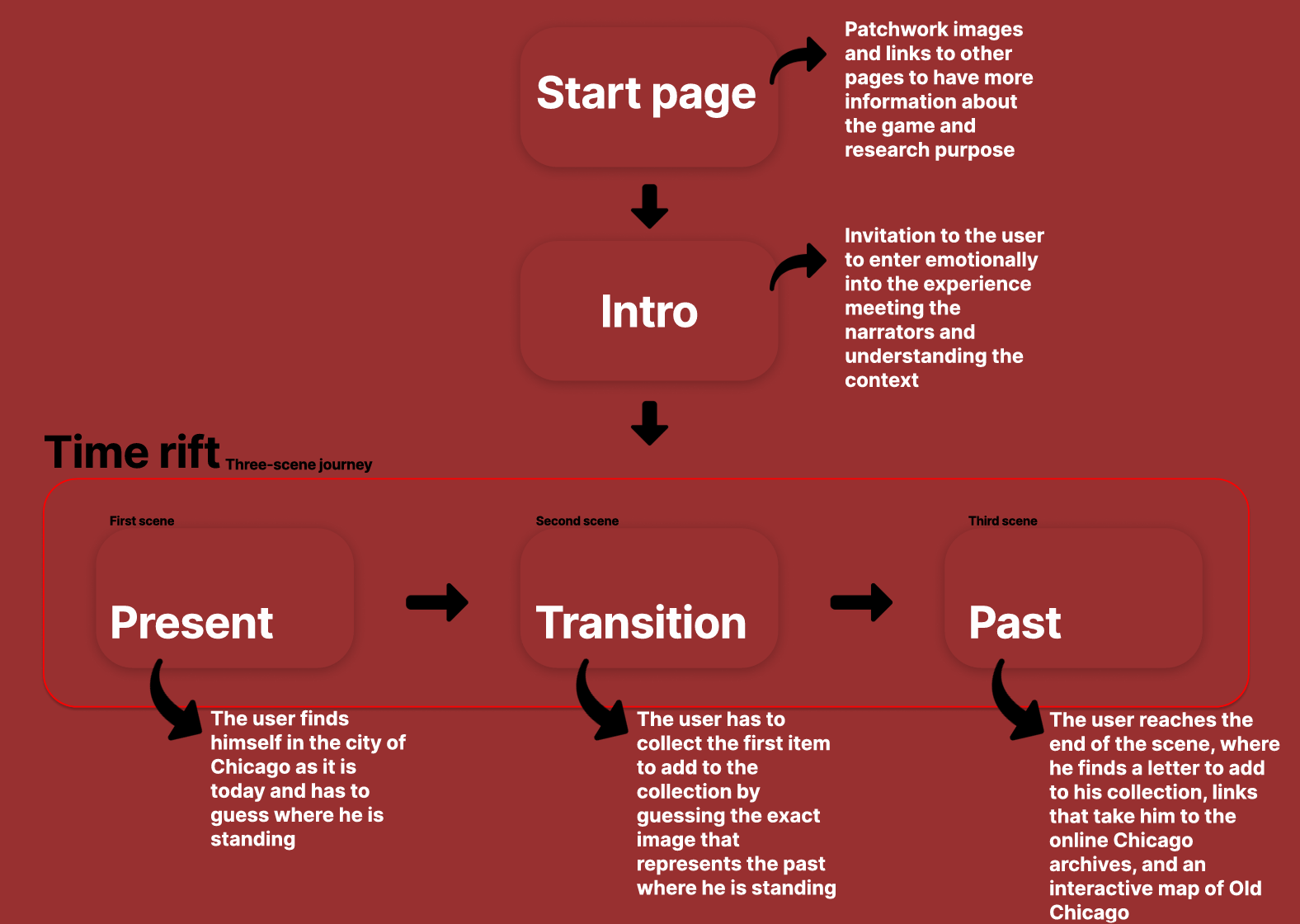
A walkthrough of the creation method.